Monday, 2 November 2020

BUTTERFLY SIGHTINGS SUMMARY 2020


This is the summary of the UK butterflies I have seen this year.
My aim is to see between 45 and 50; the last two years I managed 47. 

We were in lockdown when the first of the spring butteflies were on the wing. My first sightings of the year were on the local  disused golf course  during the  weeks of 'lockdown' due to Covid 19 when I took my daily exercise . The first records I made were on 31 March: peacock, brimstone and small tortoiseshell.

 During the next couple of weeks  I added a comma to my year list, together with orange tip and green veined white, again all seen at the golf course.
small tortoiseshell

orange tip (m)

brimstone (m)


comma

peacock

green veined white


Still limited to local walks, in the middle of April I I was please to find five speckled wood butterflies,  and a small white at the golf course.  In my garden the holly blues had also begun emerging and at Highworth's Pentylands country park, I found my first red admiral. On 12 May as restrictons were about to be lifted I saw a large white as I walked through the fields to Pentylands.

 In the middle of May we were at last  permitted to visit places further afield,  and it was time to do some  serious catching up on the butterflies which I would normally have seen by now. I therefore headed over to my usual hot spot at Oakley wood near Cirencester for Pearl bordered Fritillaries followed by a visit to Rodborough Common where I clocked up seven more species ; duke of burgundy, small heath, dingy skipper, brown argus, small blue, adonis blue and common blue .The following day I visited Morgan's Hill and ticked off Marsh Fritillary, grizzled skipper ( my first for several years!) and small copper. I felt my year list would be reasonable after all!

brown argus

common blue

dingy skipper

duke of burgundy

small blue

small heath
Adonis blue


Less than a week later  I decided to make the  drive to Bucknell Wood (after a visit to Farmoor reservoir),  in order to look for wood white butterflies, and was glad I did as I found half a dozen.

wood white


It is always good to add a never seen before butterfly to my year list, and I decided this year I would target the small pearl bordered butterfly. Having tried unsuccessfully to find it in previous years at various locations ( usually being either too late or too early in the season) I decided my best chance was to travel down to  Priddy Mineries in Somerset after reading some reports of sightings in the area. My visit paid off, even to the extent of having one land on my camera bag, and I was able to add species number 51 to my personal records list.

small pearl bordered 


With the end of May approaching, a further visit to  Morgan's hill  yielded a single green hairstreak and my first large skipper and meadow brown of the year. 

green hairstreak


large skipper

meadow brown
Some good weather in early June gave me the opportunities for specific butterfly recording;  I found black hairstreaks at Bernwood Meadows ( a change from my usual location at Whitecross Green wood, which was closed) , large blues  and marbled whites at Daneways, and silver studded blues at Silchester Common. 
black hairstreak

large blue

marbled white

silver studded blue


A few days later I located small skippers and dark green fritillaries at Cherhill.
dark green fritiallary

small skipper


I paid a visit to Ravensroost wood at the end of June to see White admirals and Silver washed fritillaries, but despite searching several times in July , I failed to record any white letter hairstreaks, which was a disappointment. I shall have to find a more reliable location another year I think, as it is rare that I have seen more than one at any time at Ravensroost anyway. I did record a probable Essex skipper in the meadow,

essex skipper

silver washed fritillary

white admiral


A revist to Bucknell woods in mid July, this time to meet my sister, enabled us to find  purple hairstreaks and ringlets but sadly no more wood whites, as it is between broods. No purple emperors either. A week later I added chalk hill blues to my list from a visit to Lardon Chase, on the way to visit my daughter who had also  just discovered she has purple hairstreaks visiting her garden  from an old oak tree at the back of her garden.


purple hairstreak

chalk hill blue

ringlet


By the end of July, brown hairstreaks were already on the wing and I made my customary visit to RSPB Otmoor to find some. I had also been seeing plenty of gatekeepers about.

brown hairstreak
gatekeeper


A conifer plantation  at Mortimer, in early August gave me my usual grayling record, although I only saw two this time,  and during a visit to Labrador Bay looking for cirl buntings, I spotted several wall browns, an unexpected bonus from the visit. 

wall brown

grayling

I was unable to record any silver spotted skippers at Aston Rowants;  the day I visited was unbearably hot and also breezy so nothing was settling. 
I did however get a final tick of the year  with some clouded yellows at RSPB  Otmoor in an area I had not previously visited known as Julys fields, having found details on the Upper Thames butterfly blog of some that had been seen there. 


During the year I have heard that it may be possible to see  Glanville Friitillaries at a site near Croydon, rather than at their stronghold on the Isle of Wight, and there were also autumn records at Brighton for Long tailed blue, another visiting migrant. Maybe next year....

My total for the season was 44. 

.


Thursday, 15 October 2020

AUTUMN VISIT TO SLIMBRIDGE WWT


The leaves were beginning to turn at WWT Slimbridge when I visited this morning on a day off. Reports are also coming in of some early winter arrivals, namely a few white fronted geese, pintails and wigeon. However, my main reason for  visiting was because there has been a curlew sandpiper easily viewable from the Rushy Hide, also a couple of juvenile spotted redshank. 

 I made for the Rushy Hide first of all, as I usually do, but there were already the maximum number of people inside. I decided to wait, hoping that someone would decide they'd seen and photographed enough and leave before too long.  I didn't have to wait too long, before a space became available, and putting on my face coveriing, went inside to look out onto the shallow pool to the left of the hide. Someone quickly pointed out the curlew sandpiper to me, feeding from the edges of a small island, occupied by a good number of teal. I don't think I've had such good views of this bird before, so enjoyed watching it through my binoculars. I found a couple of redshanks, but sadly not their spotted cousins today. Next I 'did the rounds' of the other hides on the reserve, a little egret was on the pool viewable from the Estuary walkway, and the whistling of a large flock of wigeon was heard before I'd even entered one of the other hides overlooking a pool in front of the Tack Piece. These were a definite new arrival since my last visit. 

There was nothing notable that I observed from the other hides, although I'm sure, had I had a 'scope' there would have been more to see. 

wigeon


little egret


cranes

redshank


curlew sandpiper


Thursday, 1 October 2020

BEARDIES AND EGRETS


This week I only had one day free, and it happened to be a fine day between two days of forecasted heavy rain. I therefore felt I had to make the most of it as I hadn't been out for a walk at all this week. 

Recently, I read a local blog  recounting a  visit to Avalon Marshes, an area I'd visited several years ago on the Somerset levels where I had some close encounters with some bearded tits. Not having seen one of this species this year, I decided it would be make a nice day out. My previous visit was on a Saturday morning in mid-October, when I was able to leave at 7 am. but  today being a weekday I wanted to avoid the rush hour if I could ,so left an hour later. Even so I was surprised that I wasn't held up along the A419 dual carriageway down to the M4. In fact I had a very good journey down to Somerset, apart from a slight delay just before the junction with the M5 where the exit to the northbound motorway was closed off. 

 I arrived at just before 10 am; the car park  had been closed for resurfacing but it was due to re-open today  so that worked well for me. There were already a good number of cars there and I began to wonder if the boardwalk to the Island hide  I was aiming for,  would be busy with birders, particularly in view of the fact that a spotted crake had been reported  a couple of days ago. This particular area  is a favourite place to spot bearded tits, which are encouraged onto the board walk to feed from the grit and food put down for them. 

However, there were just three people there, plus a lady with a clipboard who I learned was part of a group of people recording numbers of bearded tits. Despite a sunny drive down to Somerset, it had now clouded over and although not cold, it felt as if there might be a bit of rain around before long. I stood on the board walk with my camera, prepared for a bit of a wait, but it was only ten minutes before the 'pinging' sound of bearded tits was heard and first one then two, then a flock of about twelve birds flew  into the reeds nearby and proceeded to climb to the top of the reeds and then fly to some dead branches protruding above the reedbed. . These are one of my favourite birds, especially the male with his black  'moustache'. They flew off in groups and although you could hear them  although they were not  always visible. 

Hoping that they would come back either close by  in the reeds or to  visit the boardwalk, I continued to wait.  occasionally conversing with the other two photographers present.. Sure enough I soon spotted a male emerging through the reeds onto the boardwalk where he proceeded to feed for several minutes undisturbed. A female later joined him.   For the next half hour or so  I watched several individuals popping in and out of the reeds every so often  and at one point there were five birds; three males and two females.     
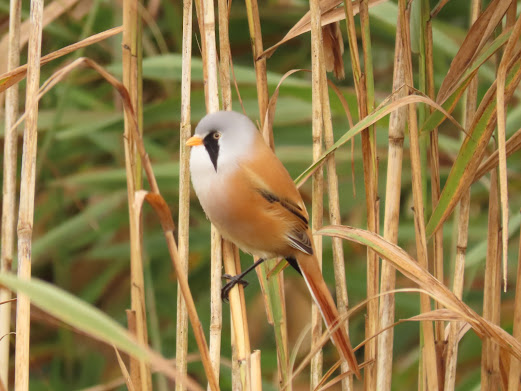


When there were no more birds left on the boardwalk, I decided to go and explore more of the reserve' the lady recorder had suggested visiting the North hide which my map showed me was at the far end of the reserve. As I turned onto the track signposted 'hides' I spotted a couple looking  at something moving in the grass alongside the hedge. A small dark furry animal -- a  mink!  It seemed quite unaware of being watched as it moved amongst the grass. Although quite 'cute' looking, these non native species are unwelcome visitors to waterways, because of their predation of creatures such as water voles and young kingfishers, 


I left it to continue its journey and carried on along the track, passing a wooden carving of a flock of starlings, as a reminder of the large starling murmurations which are well known in the Avalon marshes area. 


I caught up with another gentleman and we got chatting; I enquired if he was local but he informed me that he'd driven down from Swindon!  He'd been told that a large flock of up to  50 cattle egrets were currently with a herd of cattle at the end of the track so I decided to carry on past the North Hide to find them. We saw half a dozen in a field on our left before coming to a bridge from where we counted a  further 30 - 40 birds, all feeding among some cattle. I've only ever seen one or two at once before, so this was quite a spectacle. 

You couldn't get  too close as they were very nervous and easily took to the air before resettling again. We also saw three great white egrets along the route to the hides. 
In the end we didn't visit any other hide as there was a lot of  ' strimming' going on  which would deter much bird presence around the area, in any case it was nearly lunch time so I decided to return to the car and eat my picnic before setting off for home. Another enjoyable and memorable trip. 


THE EASTLEACH SHRIKE AGAIN

I paid my  third (and final?) visit to  Eastleach Downs yesterday to see the Long Tailed shrike which has been resident there for the past m...