Monday, 25 May 2020

THE PEARLS OF PRIDDY


It is always nice to be able add a new species to my butterfly list, and with a bank holiday free I decided it would be a good time to seek out a small pearl bordered fritillary. I have tried, unsucessfully on two occasions to find these at Bentley Wood near Salisbury but sadly was always too late , usually because family committments and/or unsuitable weather on a Saturday prevented me from going earlier. In fact the numbers have also been reducing there and the blog hasn't recorded any of them at all in recent days. Last year I visited Priddy Mineries in Somerset in the hope of finding one from a second brood but again had no success. 

However, now was in the middle of their usual flight perid so I was hopefully of adding this species to my  list of species seen. It was already sunny and quite warm when I left home at 7.45 a.m and after filling up with fuel, I made the trip down to Somerset, arriving shortly before 9.15. Two other cars were already parked in the long layby and as I shut the car door I suddenly saw an orange butterfly fly off . Could that be the  fritillary I was looking for.? 

Priddy mineries was once a lead mining area but is now a nature reserve with a wide range of flora and fauna. Priddy pools forms part of the reserve and supports all three types of newt and a range of dragonflies.

Heading down the main track I made for an area where I remembered I had seen most butterflies on my previous visit, passing a stonechat and whitethroat both perched up on some brambles. 
This was a sheltered grassy area next to a grassy mound criss crossed with narrow paths. Initially there were not many butterflies about apart from a few small heaths so I took another track past a pond where some people were fishing. I did spot a couple of possible fritillaries but they were not near enough to identify so I returned to my original spot. It wasn't long before I  saw a couple of bright orange butterflies much closer. Eventually one of them landed, and I could see it was a fritillary. Another surprised me by  landing on my camera bag, and gave excellent views whereby I could identify  clearly the upper wings as a small pearl bordered fritillary!. However, my phone was inside the bag and my main camera could not focus at that close distance so no photo possible!  Eventually I managed to get a few shots of the fritillary with wings open amongst some dry grass. As it became warmer the butterflies seemed more reluctant to land and I had to be satisfied with watching them fluttering over the grasses. The maximum I saw at any one time was 3 but I think I saw about half a dozen individuals altogether in different places. 

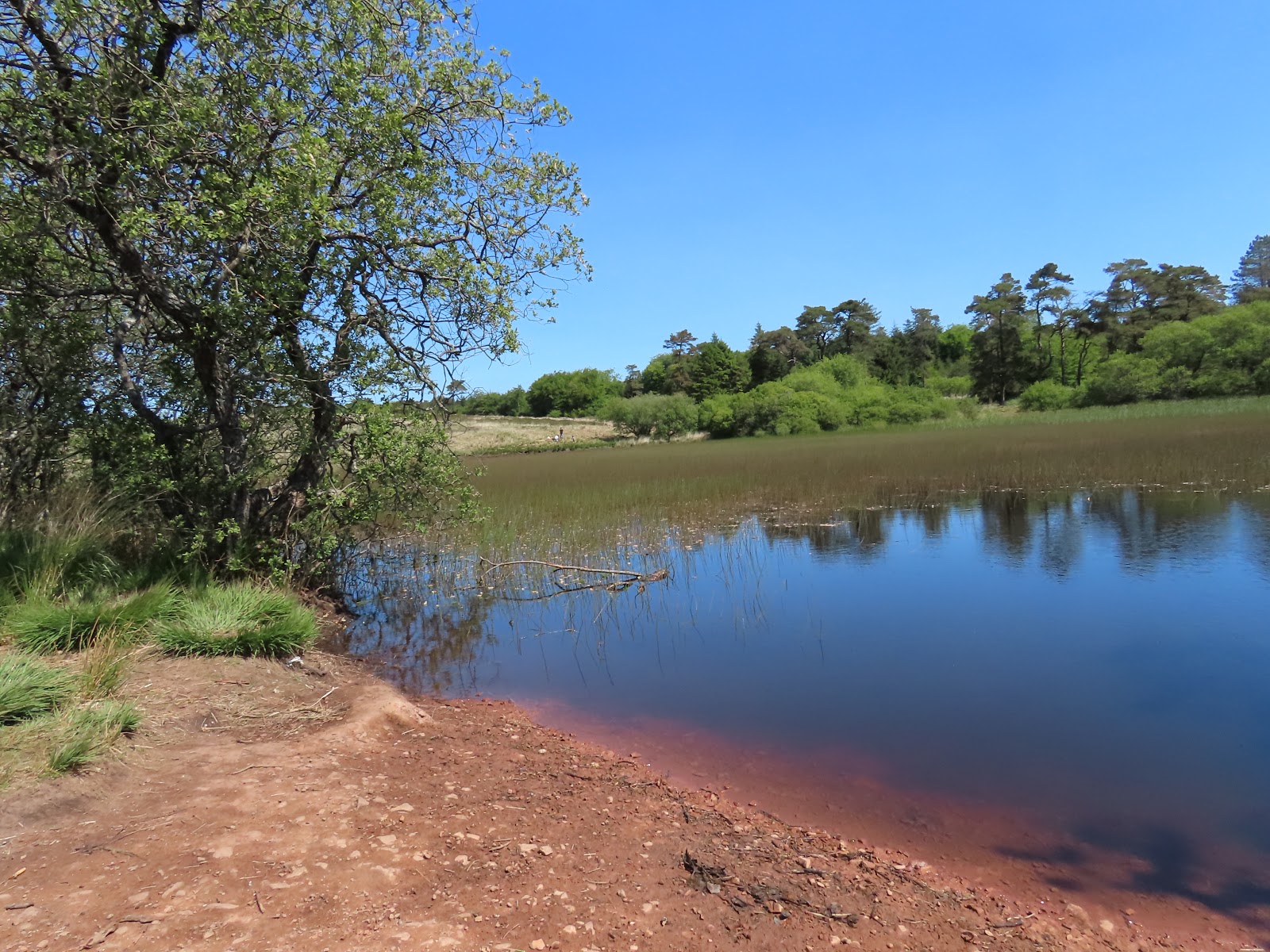
As it was nearing lunch time I returned to the car stopping off for a while to sit in the warm sun by the large pool to admire the damselflies and dragonflies. After lunch I decided to walk a hundred yards or so down the road to Stockhill woods. This piece of woodland is known for long eared owls and nightjars but I was obviously not going to see them today. It was also busy with day trippers so after a short circular walk I headed back to the mineries.    It felt as if a breeze was picking up so I thought it might encourage the fritillaries to settle and close their wings. At my original spot I found a couple of butterflies and one of them did settle for a bit and I got a quick shot showing  the underwings with their 'pearls' although as before it was hidden amongst some grasses.  By now it was getting quite hot and more and more people were turning up at this beauty spot so it was obviously time to go!! However I pleased to add number 51 to my list of species seen, Only 8 more to go but several of these will necessitate trips up to the north of the country and one over to the Isle of Wight which will obviously need a bit more planning!
view from layby
track through the reserve


a peaceful spot by the pool


Friday, 22 May 2020

DAMSELFLIES AND DRAGONFLIES


As it was quite windy today I decided to visit a couple of neighbouring nature reserves, which are fairly local to me, and see whether I could find any damselflies or dragonflies in any sheltered spots. 

Coln Country Park, despite its grand name, is little more than a sailing lake with a path around the circumference. However it has attracted some rare birds in the past including great northern diver and a female long tailed duck; the latter being seen during 'lockdown' so was not broadcast for fear of attracting too many birders which was a shame  as it would have been a first for me.  The initial part of the footpath around the lake is  quite exposed so was pretty gusty, but providing good conditions for a group of windsurfers. However as I walked towards the opposite end, a band of trees provided shelter and here it was quite warm in the sunshine. There were a few birds on the lake; a great crested grebe and a coot was all I saw, although I heard reed warblers in the long reeds around the edge and a couple reed buntings were singing from their perches in some taller bushes. 

However, there were large numbers of blue damselflies; it was difficult to tell whether azure or common blue damselflies, but when checking google I have found you need to look for either a' mushroom' shape or a 'U' shape on the second segment of their body to determine which is which so   I therefore examined carefully my photos when I got home and realised that I had some of each! 

A larger dragonfly was also flying about and when at last it settled I was able to determine that it was a four spotted chaser. 

After completing my walk at Coln Country Park, I drove round the corner and parked at Whelford Pools, a  Gloucestershire Wildlife trust site. I have done some bird watching at this site before but as the hides are shut due to the coronavirus pandemic this was not my aim today. I walked partway along a footpath nothing the hundreds of blue damselflies but returned to the smaller of the two ponds where it was easier to spot and photograph the different species of damselflies. On the pond I noticed a species which had just a blue tip to its tail, so I took a few photos of different individuals. However when I returned home, I noticed that one was slightly different in having red eyes. No surprises -- this was a red-eyed damselfly, the others again, aptly named blue-tailed damselflies! 

Another local hot spot for dragonflies and damselflies is Lower Moor Farm, this time owned by Wiltshire Wildlife trust. Between the two sites ( Whelford and Lower Moor Farm) there can apparently be found seventeen different species but like butterflies, they have different flight periods. 

Coln country park - Bowmoor sailing lake


common blue damselflies
common blue  damselfly - note mushroom shape on second segment

azure blue damselfly - U shape on second segment


four spotted chaser


blue tailed damselfy


red eyed damselfly


Wednesday, 20 May 2020

WADERS, WAGTAILS AND WOOD WHITES


Beautiful sunny weather once again and who can resist being outdoors enjoying wildlife? A trip to Farmoor was my choice today,  now it has reopened, and there have been several reports of waders there which were of interest to me. 

I took my usual route along the causeway, where often waders are to be found at the shoreline of the reservoir. On either side, great crested grebes, mallards, gadwall and mute swans were dotted about  on the water, with pied wagtails flitting up and down on the causeway walls. 

Half way along I  hadn't seen any waders and had  begun to wonder whether the waders were still around, but l then looked down and spotted a trio of tiny waders just ahead of me. There were two sanderlings and a dunlin feeding at the edge of the water. I walked past them for a bit,  and then sat on the wall and waited for them to approach which they did before turning back and retracing their steps. Farmoor has provided some great opportunities for close up views of waders. Dunlins are frequent visitors, and this one was in its summer plumage, sanderlings are less frequently seen so it was pleasing to see them today. At the far end of the causeway nesting rafts were occupied by blackheaded gulls, coots and a couple of greylag geese. 

I learned that just before my arrival there were some turnstones about, but disappointingly they had  flown off , though checking the blog later they did return .With sunny weather set to continue I hope to back,  as there are often terns and swallows etc there too.

From the causeway I decided to go down the sloping path to the nature reserve and take a walk along the banks of the River Thames which adjoins it. It was a tranquil scene and I could hear two cuckoos calling from trees on the opposite bank, but I couldn't spot them; they may well have been quite distant. Someone told me that they are quite mobile and he had seen them, both in flight, the female being an unusual rufus bird. 
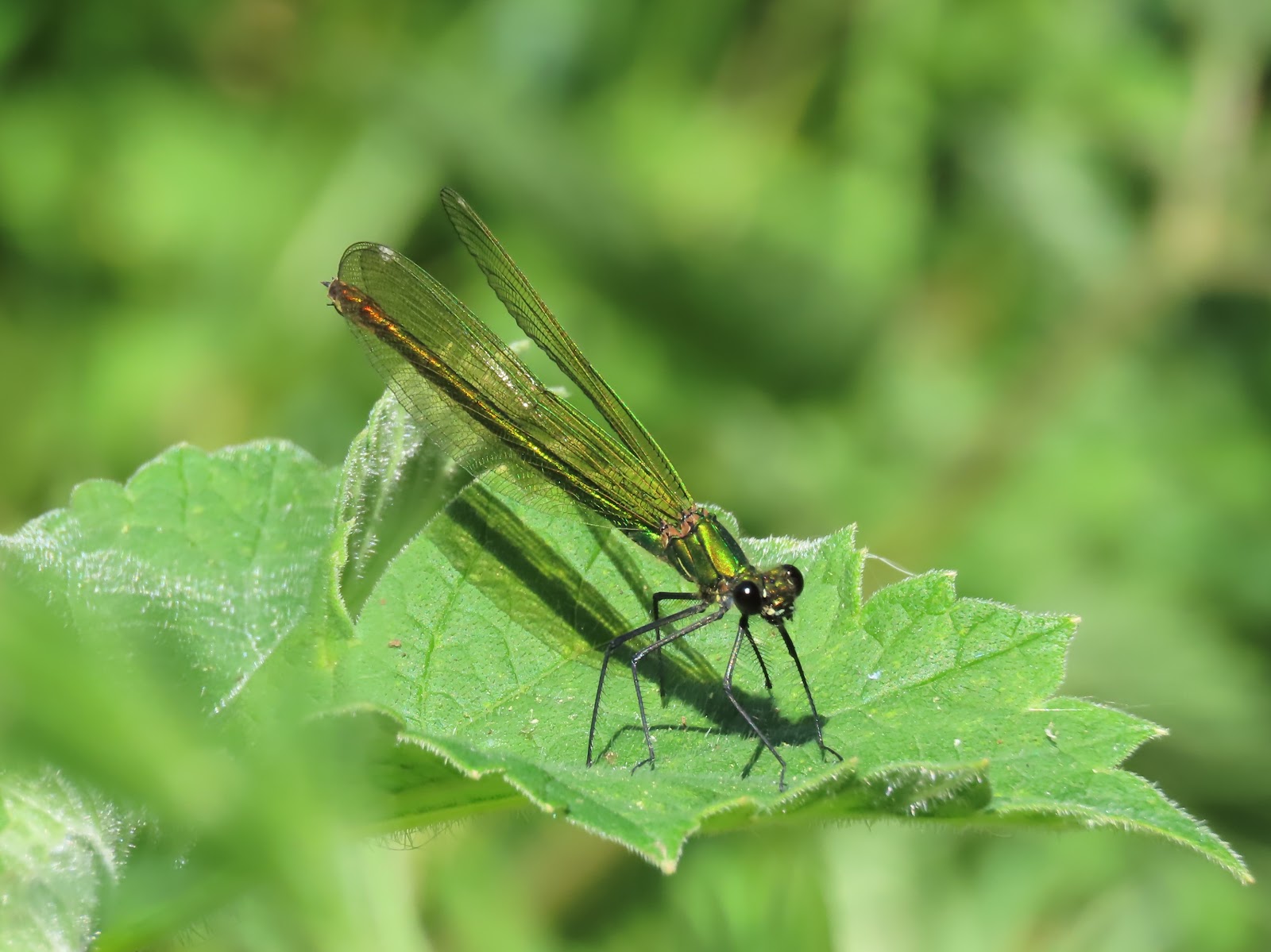
Just below the opposite bank I spotted a couple of grey wagtails. After discussion with another birder we decided they were young birds, and in fact we realised there were actually four of them. In my quest for dragonfly species I saw several male banded demoiselles and lots of azure blue damselflies. A green  individual  caught my attention; but although I initially thought it might be a new species, checking it on google, it turned out to be a female banded demoiselle.  


great crested grebes

sanderling and dunlin

sanderling

sanderlings


three amigos!
by the Thames

juvenile grey wagtail

When considering what butterflies I still needed to add to my year list, I  realised that wood whites were already on the wing and a good place for them is at Bucknell woods, a site I visited last year for the first time. As it would be just over half an hour further on from Farmoor, I decided to head north toward Silverstone where the woodland is situated and arrived at 1.45 pm. After eating my lunch I walked up the main track where I had seen the wood whites last year.  As I glanced ahead, I caught sight of a roe deer  standing in the middle of the track albeit somewhat distant,  but after staring at me for a few seconds it quickly disappeared amongst the trees.  I spotted a few whites but they were larger and had a stronger flight than the species I was looking for and hoped that I hadn't made the journey in vain.   Eventually I saw  a white butterfly with rather a weak flight fluttering along the grass at the side of the track, which conveniently settled close by;  its rounded wings confirming its identity as a wood white. After this  I saw probably about ten individuals, but that was the only one that settled. 


Saturday, 16 May 2020

WATERHAY WARBLERS


I decided to carry out today's exercise  this morning, through a visit to Waterhay in the Cotswold Water park. Arriving at 10.15, the car park was considerably more full than I've seen it before, though I must admit I don't often go there on a Saturday morning.  I hoped that there would not be too many times when I'd need to squeeze into the hedgerow to allow people to pass! 

As I left the car, the first sound that struck me was that of a cuckoo calling, my first this year but hopefully the first of several. I decided to take the path leading to Lake 82 rather than direct to Cleveland Nature reserve, as last year I'd heard and seen a grasshopper warbler there, and there have been reports this year too. However,  their unmistakeable reeling sound was not heard today. A reed bunting was perched up in a bush nearby and also sedge warblers and reed warblers both singing at the same time, and allowing a comparison to be made between the song.  The increased leafiness of the trees, however, made photography difficult..

I left the lakeside to rejoin the main track where some sandmartins were perched up on some wires. I could see a blackcap singing, but with garden warblers having a similar song, I couldn't confidently say whether there were any garden warblers around the area which was a species I had hoped to find. Heading back to the carpark, along the main path, I heard chiffchaffs and willow warblers. It was then I bumped into a friend with her family who are keen birdwatchers. They had their binoculars focussed on a bush at the side of the path and on enquiring, it was a garden warbler!  I could see it clearly through binoculars but sadly the sun was right behind it, allowing only a dark silhouetted photo. 

I have also started noticing dragonflies and damselflies, so was pleased to find a new species, a male banded demoiselle, its  blue green body gleaming in the sunshine.

view over lake 82

reed bunting

sedge warbler
banded demoiselle damselfly


Friday, 15 May 2020

MORGAN'S HILL BUTTERFLIES


Another sunny day forecast and with a few early butterfly species I still wanted to add to my year list, I had to make the choice which reserve to visit. I checked out the Witlshire Butterfly conservation sightings list and decided that all the ones I hoped to find had been seen at Morgan's Hill reserve near Bishops Cannings, a site I've visited on several occasions before. My target species were Marsh Fritillary, green hairstreak, grizzled skipper, small copper and wall brown( although the latter two would be still flying later in the year)

Hoping that the carpark would be open I headed over to Morgan's hill picnic area, and was relieved to find it was, although  it had quite a number of cars in it and some vans. I followed the main track from the carpark up hill and came to the gate into the reserve. However, it had a sign requesting people not to go on that area which was being kept safe for the rare Duke of Burgundy butterflies. It didn't matter really as I continued along the track where I knew there was a gate into the reserve just about where I expected to find some Marsh Fritillaries. It was still a little cold and to start with I could not see any butterflies at all although it was clear and sunny. But then I saw one, which happily turned out to be a Marsh Fritillary. It kept flying and landing and provided some photo opportunities though often it would land down amongst some grasses and be partially obscured. I saw a couple more of these before making my way back up hill. I  continued to follow the path through a kissing gate until I came to an area above what is known as the quarry, and from memory I knew that this would be a sheltered spot.

Down in the quarry I met another lady who was also looking for butterflies. I enquired if she had seen any grizzled skippers as those of you who  occasionally look at this blog may remember this species has eluded me for the past three years!! 
She told me she saw quite a few in that area about 10 days ago but hadn't seen any today, but had found a small copper although it had flown off before she could photograph it.  I stayed in the area for a while, then wandered off to see what else might be about but after a few minutes heard a call to say she had seen  a couple of grizzled skippers flying about in the area. They had gone by the time I reached her, but she assured me that they would probably return which they did and I was finally able to photograph one of them!! They are attractive little butterflies, much brighter in colour than the dingy skipper but not as common and I was delighted that at last I had (with a little help!) managed to locate one. 

Later we did find another small copper but although we looked again for green hairstreaks they were not to be found. 


marsh fritillary

grizzled skipper

marsh fritillary
small copper


marsh fritillary

Thursday, 14 May 2020

BUTTERFLY CATCH UP

 With some lockdown restricitions lifted I took the extra opportunity to go and find some of the butterflies that have emerged in areas a short distance from home. 

My first location was Oakley Wood, near Cirencester, where I have regularly seen Pearl bordered fritillaries. They are just about the only butterfly I see there, apart from an odd white one so I wanted to tick that one off. It was actually quite cold this morning with a bit of a breeze, so when leaving the house at 10am it was still only 9 degrees, and I wondered if it would be warm enough for any butterflies to fly. One other car was there in the woodland parking area but  it looked as if the occupants were just going for a walk so I  made for the area in which the Pearl bordered butterflies are usually found. Taking the usual path from the main track, I noticed how overgrown everything seemed and I could hardly find any bugle flowers which the butterflies favour. However, I kept on and eventually came to a further path which I followed for a few metres and things became easier, with bugle flowers in bloom. With clear blue skies overhead and sheltered from any wind,  I was looking hopefully round, when I  suddenly spotted an orange butterfly and was optimistic that this was what I had come for, which it proved to be. In all there were about 5 individuals flying about, and often settling so it was good to be able to get a few photos.


With the temperature rising, and still plenty of sunshine around, I decided to make my way over to Rodborough Common a further 15 minutes on. I passed through Minchinhampton common which adjoins it and noticed that there seemed a lot of people about, amongst several herds of cattle which roam freely at this time of year. I wasn't sure whether this would be the same at Rodburgh and as I approached there seemed a lot more cars than on my usual visits. However, being nearly lunch time, cars were leaving and I managed to find a space. 

I walked down toward the area I usually find the most butterflies, checking the hawthorns briefly for green hairstreaks but saw none. I did catch  a glimpse of  a pale brown butterfly which I identified as a small heath, another tick for this year but not much else as it was still quite breezyWhen I eventually reached the sheltered part of the common I made my way down to the bottom of the slope, and here I looked and could see lots of small butterflies all fluttering about, some blue, some brown. By following different individuals I was eventually able to identify a further 7 new species for the year, including two Duke of Burgundy butterflies. Others included common blue, small blue, Adonis blue ( I just found the one on some dog poo!), brown argus, dingy skipper, small heath. I was surprised that I was the only one around looking for butterflies maybe others are waiting for the weather to warm up a bit more, else they are of an age where they need to be shielding!  Although I checked lots of bushes, I still could not locate any green hairstreaks so that's one I shall have to look for elsewhere. A rewarding few hours!

common blue

dingy skipper

duke of burgundy

small blue

small heath

Adonis blue

brown argus


LONG TAILED BLUES AT PORTSDOWN HILL

My best butterfly year is continuing as I added another rare species to my year list today. Long tailed blues are relatively scarce migrants...